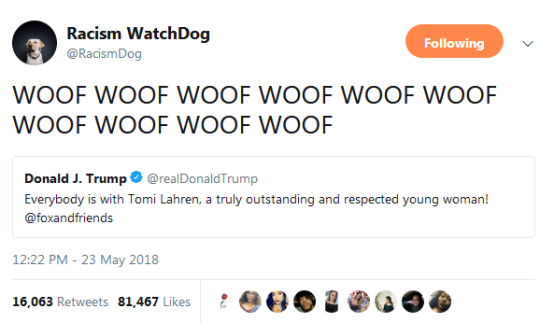
this is what radical political comedic satire looks like
im Here for publicly funded jokes at his expense
Anyway, here’s how to donate to Sesame Street and support PBS with donations. Talking about how awesome a thing is can be great if you also take action to support it.
Here’s a cool trick to see if a man actually respects you: try disagreeing with him
A friend of mine did something with online dating where, before meeting a person, she’d say no to something minor without a reason for the no. For example: “No, I don’t want to meet at a coffee shop, how about X?”, or “No, not Wednesday”, or “No, I don’t want to recognize each other by both wearing green shirts”. She said how the potential dates reacted was a huge indicator of whether she actually wanted to meet them, something I readily believe.
I’ve mentioned this to a few people and sometimes I get very annoyed and incredulous responses from guys about how are they supposed to know that it’s a test if the girl is being unreasonable? How are they supposed to know that and let her have her way? I find it difficult to explain that if you find it unreasonable for someone to have a preference of no consequence which they don’t feel the need to explain, then you are the one being unreasonable. You can decide for yourself that it sounds flaky and you don’t want to date her, but you don’t have a right to know and approve all of her reasons for things in order to deign to respect that she said no about it. Especially in the case of someone you haven’t even fucking met yet.
The point isn’t to know it’s a test, the point is that if you would only say “yes” if you knew it was a test, then what if it’s not a test, but because she hates coffee shops, or because she’s attending a funeral Wednesday and doesn’t know you well enough to want to share that, or whatever else? Because if you’re making rules for when other people can have preferences and not explain why… yeah, that is a thing they can reasonably want to avoid.
@ all the angry dudes in the replies: the point is not to trick or manipulate men. The point is to see how a potential romantic partner reacts to a minor inconvenience. If they say, “oh, ok, would seven work instead?” or “well there’s this Armenian tea house I’ve been meaning to try out, want to go there?” then that’s a good sign that they’re safe to date. If they throw a fit and/or demand to know every little detail about your rationale over something as simple as rescheduling dinner plans, that’s a bad sign. A really bad sign.
It’s like this, dudes. Women in Western society are socialised to cooperate and compromise. Some men are socialised to get all their own way, all the time. These dudes are incredibly dangerous to women their partners,* and the only way to tell them apart from the OK guys is to pay close attention to how they react. If you’re one of the OK ones, this isn’t about you. Learn to take “no” for an answer, and you’ll be fine.
*Updated to reflect the fact that abusive men can target any gender, and the fact that I used this screening tactic to good effect during my Big Gay Slut phase.
The thing a lot of the men reblogging don’t get – they think this post is telling women to lie. They think this post is telling women to start a fake argument and to be manipulative.
Actually, this post is doing the opposite. This post is telling women to be straightforward, and forthright, and upfront about their values and opinions.
This post is telling women, “I know you’ve been socialized and conditioned to nod and smile at everything a man says your whole life, since you were 4 years old and your grandma told you that little girls should be seen and not heard. I know that by now it’s second nature to you, and you probably don’t even realize you’re doing it half the time. You don’t even realize that the laugh that just came out of your mouth is a laugh of appeasement, rather than a laugh of genuine humor. ”
It’s telling women, “Force yourself to resist your conditioning. Consciously make an effort to be open and honest in that initial conversation, when you’re making small talk, about small things. If he says something you don’t quite agree with (and he inevitably will, because nobody agrees on everything), don’t smile and concede the point like you’ve been trained to do. Consciously make a point of vocalizing your real opinion.”
It’s telling women “If a man doesn’t respect your real opinion about a small, insignificant issue when you first meet him, then he’s not going to respect your real boundaries later on when you’re in a serious relationship.”
Seriously, ladies, read this to men already in your lives. If they get outraged…maybe reconsider their place in your lives.
“If autism isn’t caused by environmental factors and is natural why didn’t we ever see it in the past?”
We did, except it wasn’t called autism it was called “Little Jonathan is a r*tarded halfwit who bangs his head on things and can’t speak so we’re taking him into the middle of the cold dark forest and leaving him there to die.”
Or “little Jonathan doesn’t talk but does a good job herding the sheep, contributes to the community in his own way, and is, all around, a decent guy.” That happened a lot, too, especially before the 19th century.
Or, backing up FURTHER
and lots of people think this very likely,
“Oh little Sionnat has obviously been taken by the fairies and they’ve left us a Changeling Child who knows too much, and asks strange questions, and uses words she shouldn’t know, and watches everything with her big dark eyes, clearly a Fairy Child and not a Human Like Us.”
The Myth of the Changeling child, a human baby apparently replaced at a young age by a toddler who “suddenly” acts “strange and fey” is an almost textbook depiction of autistic children.
To this day, “autism warrior mommies” talk about autism “stealing” their “sweet normal child” and have this idea of “getting their real baby back” which (in the face of modern science) indicates how the human psyche actually does deal with finding out their kid acts unlike what they expected.
Given this evidence, and how common we now know autism actually is, the Changeling myth is almost definitely the result of people’s confusion at the development of autistic children.
Weirdly enough, that legend is now comforting to me.
I think it’s worth noting that many like me, who are diagnosed with ASD now, would probably have been seen as just a bit odd in centuries past. I’m only a little bit autistic; I can pass for neurotypical for short periods if I work really hard at it. I have a lack of talent in social situations, and I’m prone to sensory overload or you might notice me stimming.
But here’s the thing: life is louder, brighter and more intense and confusing than it has ever been. I live on the edge of London and I rarely go into the centre of town because it’s too overwhelming. If I went back in time and lived on a farm somewhere, would anyone even notice there was anything odd about me? No police sirens, no crowded streets that go on for miles and miles, no flickery electric lights. Working on a farm has a clear routine. I’d be a badass at spinning cloth or churning butter because I find endless repetition soothing rather than boring.
I’m not trying to romanticise the past because I know it was hard, dirty work with a constant risk of premature death. I don’t actually want to be a 16th century farmer! What I’m saying is that disability exists in the context of the environment. Our environment isn’t making people autistic in the sense of some chemical causing brain damage. But we have created a modern environment which is hostile to autistic people in many ways, which effectively makes us more disabled. When you make people more disabled, you start to see more people struggling, failing at school because they’re overwhelmed, freaking out at the sound of electric hand dryers and so on. And suddenly it looks like there’s millions more autistic people than existed before.
“…disability exists in the context of the environment.”
Reblog for disability commentary.
That last paragraph is absolutely important.
There’s also some disabilities that effectively don’t exist in a modern environment. Shitty eyesight, for example, is 99% of the time effectively and easily treated with glasses, and is not a disability at all (assuming you can afford the glasses, of course). I don’t have to go to my school’s disability services and request accommodations because I need glasses, and I don’t have to alter my daily life because I wear glasses, because today’s modern environment is perfectly navigable to a person with glasses. If I lived 500 years ago and had the same shitty eyesight, it actually would cause me problems. If only we build the world to accommodate other disabilities the way we accommodate glasses.











 Tumblr backup