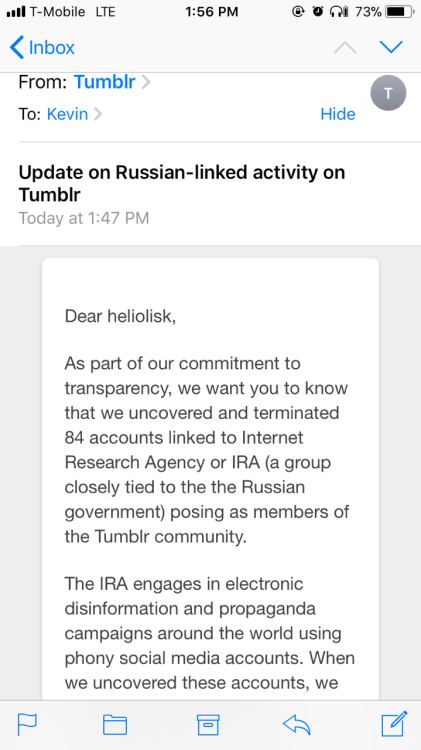
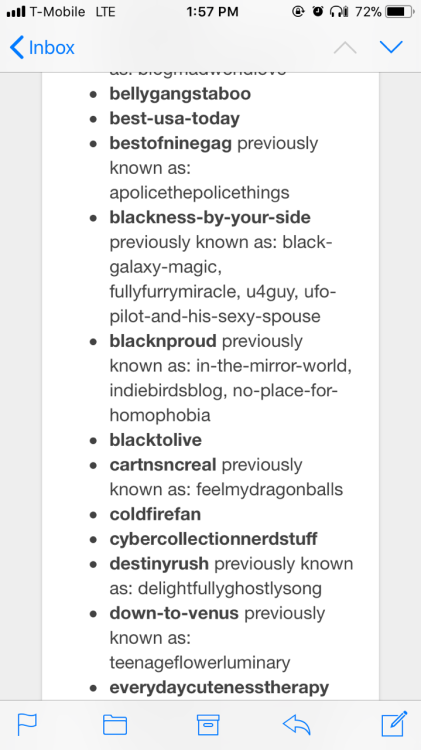
Yall i just got an email from tumblr saying I interacted with accounts made by the IRA …… is this even real????
The internet is wild
Im literally imagining some government worker in russia logging onto tumblr.edu and thinking to themselves “better change my url to ‘black-galaxy-magic’ to stay young n hip and relevant with the youth of america”
sooooo let’s break it down then because the fact that tumblr sent this email is mega important
so to sum up, the email you and a ton of other people got is saying that you were following and sharing posts from russian pro-trump propaganda blogs. i’d ask that you PLEASE reblog this, because it’s super important that everyone who got this email knows why they got it, knows what it means, and hopefully knows what they might be able to do better in the future
I’ve already seen people claiming that Tumblr is just deleting blogs because they spoke out against something. You numbskulls- read this and then say that again. That’s how they got a platform- they never actually cared about any of the issues they posted about. It was all a ruse.
I WANT BULLET TRAINS IN THE USA CONNECTING EVERY DAMN CITY/METRO OF OVER 1 MILLION PEOPLE. I SHOULDN’T HAVE TO PAY $350 TO FLY FROM BOSTON TO KANSAS CITY AND BACK WHEN YOU CAN DO A ROUDTRIP FROM DUBLIN TO BERLIN FOR $60. ITS RIDICULOUS
Greene. Carter. Lewis. Weaver. Lockhart. Benton. These are the names of TV characters on viewers’ lips, characters on one of 2018’s hottest TV shows…a show that happened to premiere nearly 25 years ago. Now on Hulu, ER is having a second life.
The 15-season series made its streaming debut in January with much fanfare. Sure, ER has been off and on TV in syndication (most recently on Pop) since it ended its run on NBC in 2009, but the show was never accessible all at once on a (legal) streaming site. With all episodes now at their fingertips, viewers are eagerly eating up the series.
ER made its streaming debut on January and continues to be one of @hulu’s top shows. More than 35,000 viewers have finished all 15 seasons since launch. That’s 240 hours of TV, an average of five episodes of ER per day. I spoke with Sherry Stringfield (nbd, just my favorite ER actor) and a Hulu executive about the surprise second life of ER. Read it here. Love it with me.
“i can’t go downstairs, there are people there” sounds like a completely logical statement until you try to explain it to someone who doesn’t have any kind of anxiety
By industry standard, a show, within its first two episodes, TYPICALLY loses 15% of its demographic. (hence our high 2.5 becoming a low 2.2 between episodes 1 and 2.) It’s whether it can fight back against that bump, and how long it can. S1 performed well until episode 8. As it progressed, we waffled from mid 2.5s as low as a 1.3, ranging mid-high 1.x, and ending at 1.6. That’s why despite all the 2.2/4/5 at the start of the season, we averaged a 1.94. But that’s okay. It’s considered a solid show for the CW, even in that day. 2005-2006.
There is a rhyme, a reason, an ebb, and a flow to ratings. The fact that SPN diminished after its first season was no surprise. It’s no insult.
2006-2007: Season 2 We started just around the demo our S1 finale ended at and waned, again. We petered down from 1.7 to 1.2 and by the end, averaged 1.38. Okay. A little concerning we’re not holding the line, but not a critical loss, especially with even-then gradual loss to still-slow-moving TV decline with the infection of cable to american homes progressing like a silent cold. The issue is, this sunk us close to the bottom of the zone considered a solid investment.
2007-2008: Season 3 And then the decline continued, mostly within surrounding media averages of TV . 1.19. That’s fine. Really our average value dropped just a point or two in the industry’s eyes. The problem is, where S2 left us, that left us scraping the bottom of what was considered a solid or sound show investment, with a decently high budget investment (cited around 2-3 million/episode back then). But there were things going on outside of it. In 2008, the industry started seeing rapid conversion to cable. While social media expanded, barely any dreams were out in how to really apply it, streaming options were new ideas, but barely executed; ads devalued and more terrifyingly – the government put out the Digital Conversion Mandate.
Anyone old enough to be semi-adult around then may remember friends panicking that they wouldn’t be able to use their rabbit ears anymore. Cable, expensive conversion box, or bust. By 2009, all TVs would click off unless you had cable or the converter, because all stations were being forced to click to digital. And some were doing it early.
As TV went from being mostly 8-10 or if lucky in your area, 12 options per household into basic cable packages offering 20-30, suddenly, options diversified. Grey’s Anatomy’s 9.3 of 2006-7 gouged to 7.16 by 2007-08 within a year, and it was a leader still at the time. And with the conversion box looming like a threat on the horizon, by 2008-09, Grey’s would clip out at 5.73. And this reflected almost everywhere. Every major show, every major network. 10s became 5s within 2 seasons and those were our /top/ runners. And the industry wasn’t updated to even know how to address this.
With Supernatural floating at the bottom of the “okay” barrel for their bubble, (as cited by Kripke, “We were on the bubble, and we didn’t know if we’d make it”), this was a TERRIFYING time to be in production and a HORRIBLE place to be in.
2008-2009: Season 4 As Grey’s dropped from 7.13 to 5.73, and others like it mirrored it or worse (at losses of 10-30% being common) or more than 20% of its raw demographic in a single year, you can understand where the panic in the industry was. Nobody knew how to handle this. Advertisement and thus income was getting boned right in the taint.
Supernatural, hanging at a 1.19 and praying for its life, already in gradual decline even in pre-crisis curve, could easily become one of those 30% downs. Projected curve would have put them around 0.83. Or, at that point, roughly 0.2 points beneath what would make advertisers even consider them while everything was going up in flames.
But instead, something magical happened. As Dean pulled himself from his grave, so did the show.
We didn’t go down. We went up. And we were one of very, very few shows to do so.
Kripke said he was glad he had taken up the idea of angels, because it had rejuvinated the show, “in no small part thanks to this guy,“ as he gestured to Misha.
We rose. From 1.19. To 1.33 for the season average.
We bounced in the opposite direction as much as we were naturally slated to sink.
And as methods came to track this chaotic mess of transition, Supernatural’s actual retention in the industry shone well, well above the previous seasons. Season 4 was performing, amidst the industry crash, 18.2% better than season 3 before it, with and 15.9% percent better in respective retention than season 2.
And as this pandemic continued through 2009-2010, Supernatural held. It held its level, its curve, and its virtue against time. We only really started sinking lower by late season 6, despite being in what was considered a bad timeslot; it was season 7 we nuked out for real; even in, again, respective industry curve. Now, fill in the blanks of what was going on in the show during this time, I’ve written much larger coverages of this since.
But by S8/2012-13, we were back on our feet to the S4 retention value in curve. By S9, we went higher than SPN had ever been before. We experienced a minor waffle in S10, but it still kept us higher than even season 1 with its high averages; S11-12, we crept up and stayed level in retention, while streaming options that mark sales and digital calls but fail to pour into demos skyrocketed in options and shows continued to sink. And season 13 is a beautiful beast so far; at our lowest possible projections short of unexpected crash and burn, we will at least match S9’s retention; we have a chance of completely shattering it.
September 18th, 2008, when Misha Collins waltzed into the show, a new dynamic saved it from dropping through the floor both in ratings and even adapted industry curve while the entire television world turned on its head. And the only time it has fallen through that floor since is in the season they tried to remove him.
So whenever someone numbly, blindly asks, “where did this come from?” you don’t even have to just say “Eric Kripke said it.” It’s true. Eric Kripke said it. But there was a reason he said it.
And he said it because Castiel inevitably saved the show.
And Kripke isn’t the only one who’s said it.
There is Ben Edlund,
And there is even Robert Singer as of last year,
both quite interesting statements with all the “Castiel isn’t a lead”, a point I’ve already shredded by-standard here: (Link – Re: Trivial Arguing on Leads)
People say Castiel rejuvinated or saved the show because Kripke said he did because he did, and it just takes paying attention to history outside of the SPN bubble to understand why.
Adding this to further prove the point
I’m crying real tears, I knew the ratings skyrocked when Misha joined the show, but had no idea how much. Supernatural would have died tragically after season 3 if it wasn’t for Castiel’s epic entrance and Misha’s charisma.
I love Misha Collins so much. I love Castiel so much.
This unilateral industry decline, along with our previous natural decline, is something we can track too. What I advise is to go to the spottedratings.com site and investigate their “Plus” system. You can also play with comparison charts of adapted industry curve here. They track more than 150 shows and scale them to their unilateral decline across the board over their years, then make a gradient grading system that accommodates the changes in how the world views TV.
As TVByTheNumbers has the “Gunsmoke Rule”, wherein any show’s ratings more than a year prior are considered absolutely irrelevant for comparison to the current due to the rapid freefall of ratings (named after the era of Gunsmoke airing, wherein TV diversified from 2, to 3, 4, 5 stations, and ratings fell in from 50, 33, 25 over a few years respectively until we reached a plateau of average stations – ironically, we’ve been compared to Gunsmoke with our longevity too; and in our lifetime of airing a similar effect yawned open with cable/the conversion mandate), the Plus system is a public facing algorithm that lets us make an adaptive curve for all TV ratings to BYPASS the Gunsmoke Rule and be able to compare older season performance with the ongoing slant of universal ratings into the abyss.
That’s where this chart comes from. These are the respective Plus values.
And as you’ll notice it only has 12 nodes, from lowest to highest projected performance, here’s my rough graphing in of where S13 is going to fall.
SPN is doing amazing, sweetie. And Misha is critically important. Hell, check out S7.
One of my favourite anecdotes about the first Golden Age of Piracy is that, at one point, Captain Henry Morgan left England in one ship, and arrived in the Caribbean commanding a completely different ship, and nobody knows why. What happened to the first ship and how he acquired the second one are entirely unrecorded.
At some point in his short career (1715 until 1718), the English pirate Ben Hornigold attacked a sloop near Honduras just to steal all the hats of the crew, because his own crew had gotten drunk the night before and they had tossed every single one of their own hats overboard.
Bartholomew Roberts, arguably the most successful pirate in history by ships captured (a whopping 470 in 3 years), didn’t actually want to be a pirate. His ship was captured and he was forced to join the pirate crew.
People being angry about ~dem gays~ on Target’s Facebook.
I just want to give my two cents on this and tell you a story.
A couple weeks ago, I was hired at Target. I have a job at Target. Not a big deal right?
It is a big deal because i’m a transman.
It doesn’t take a genius to conclude that it’s hard for me, my brothers, and sisters to get a job. There are legal restraints regarding the job and if you don’t pass, it’s hard to be taken seriously at a job interview.
Right on the application, it asks what your preferred name is. It also asks if there is anything that target should know. I put the fact that I am a transman, expecting not to get a call because usually when you put that down, people will throw out the application. I got TWO interviews.
At the interview, they asked me about it. I told them I am on hormones and they told me that they didn’t care. Not in the sense that they don’t emotionally care, but that it didn’t matter. I was male and that’s all that mattered. They also told me that they give sex same couples benefits in states that do not recognize them as a married couple.
At my job orientation, I was not misgendered once. Even my supervisors who weren’t sure of my gender avoided pronoun use, which I found only happens when you’ve had pronoun training. They gave me a name tag with my preferred name and didn’t ask questions. I felt safe and respected, which is huge for a trans* person.
TLDR: Target is amazing not just for the LGB, but also the T. Shop there for the rest of your life.


 Tumblr backup