Like, at one point i was giving peer support to a woman with severe depression who was having difficulty in her job at a grocery store. No one liked her, she said, because she wasn’t “perky” like the Not depressed people.
After some discussion it became clear that when people tried to small talk with her, she would talk about her mother having died five years ago and she was never the same since.
She understood that people were uncomfortable because she was not, like, saying random boring shit about the weather, or being cheerful. But she believed very strongly that she should not have to act like a non depressed person, so when someone said “hi how are you” she should give an honest answer.
It upset her greatly that she had trouble advancing in her job, and she felt strongly that this was ableist, because people expected her to act as if she were not depressed.
I disagreed, because I understood her plight, but unfortunately part of working in a store is presenting a specific demeanor even if it is not how you feel. That is not a good thing—hell, “emotional labor” was coined to describe THIS EXACT THING and how taxing it is!—but it is also not a thing that one individual is going to change.
I can’t speak to other people’s opinions, but when I say that some people seem stuck in a way that is unhelpful, and seem to present “stuck” as “being true to being disabled,” this is the kind of thing I mean.
I’m not saying everyone can get unstuck. I don’t think this individual actually could, for example. But I am saying that people like this telling other people how they should act makes me uneasy, because I think people like this are missing something important.
There also feels, to me, like there is an important distinction between “greeting customers with a curt nod instead of a perky hello” and “telling random grocery store people the full personal story of my mother’s death”.
And I don’t know which of these your Cashier lady was wishing to be able to do, but I’ve seen equivalently different situations conflated by people around here.
She wanted to be able to “be honest,” which for her meant talking openly about her depression with everyone she interacted with. I tried to explain to her that that was too intimate a topic for a grocery checkout line, but she was, basically, convinced it was ableist to EVER expect her to “act NT.”
I understood how she felt but that was… not the hill to die on.
Sort of tangential here, but I am really uncomfortable with cultural pushes toward “honesty” and “authenticity”. I’m all for not having to feel like you’re living a lie, but I’ve watched “come out to fight stigma” turn into “if you hide anything you must have internalized -isms”. So much of blogging and even a lot of journalism has such a confessional bent, and I almost wonder if attitudes like that lady’s are a by-product of that?
Like, people will share the most incredibly personal stories on social media and get praised for their “honesty”, which really rubs me wrong as a descriptor. It’s not dishonest to keep some things private! You’re not LYING by not telling the world every squishy secret! The word you’re looking for is “intimacy”, which can be a virtue, but it’s not the same as honesty. And yet so many people have conflated them that I wonder if that’s the motivator in a lot of these cases.
Oh, my god, someone finally said it. The expectation of performative vulnerability makes me so goddamn uncomfortable.
(I’m also somewhat ambivalent about the way ‘emotional labor’ gets used in these contexts; like, I’m an awkward introvert with a public-facing job, and it isn’t really that taxing for me to be like… civil and helpful to my patrons. When you’re expected to tolerate abuse with a smile, or offer significant emotional engagement and support–which, ironically, it sounds like this woman was after–that’s different. But ‘don’t dump all your emotional problems on random strangers making small talk’ just seems like basic manners to me.)
Agree.
I understand that it’s hard for people who have issues with social cues to magically divine that the proper answer to “how are you” is “fine, thank you.” I had a rough time grokking it myself! And sometimes I just don’t want to say it, so I just say “oh hi name” instead or something, which generally goes over fine.
But i also wonder: if you’re an adult… why is that massively burdensome, once you know what people are looking for? Say it, roll your eyes internally, go home, and complain about NT rituals to your buddies.
I do a lot of little social stuff like that purely because it puts people at ease, and when they are at ease, interacting with them is massively less unpleasant and sometimes even fun.
I am probably going to get called an ableist witch for this, but… interaction is a two way street and not every compromise is a burden.
Also, I can almost guarantee that your example woman wouldn’t have been happy if the people she was telling about her mother’s tragic death brushed it off or displayed no sympathy.
She wasn’t asking for the space to be honest about not feeling well. If that were the case, she could answer “How are you?” with “I’m feeling about normal.” She was, whether she realized it or not, expecting emotional support from every random stranger she came across.
That is not cool, NT or not.
Yes, she absolutely was doing that, and burned through a lot of the support she was getting from people because any time we tried to tell her that was too personal, her response was basically that sure, nondepressed people can talk without getting personal, but she has a disability so she shouldn’t be expected to communicate in the way others want.
It was… exhausting even for me, and I try very very hard not to be “staffish.”
I also don’t like that kind of small talk (I’m not in a work where that’s expected), but even if you want to be honest and consider it deceitful to say you’re fine, there’s no need to go out of your way to overshare.
If you want to go for a light tone without lying you could try some neutral not-too-snarky jokes like “uuh that’s a hard one…next question?” or “sorry, that’s top secret info”, but if you’re not in the mood for it or your customer is not much of a jokester, you can just say “oh I’ve had better days” and leave it at that, shrug or redirect the conversation or otherwise discreetly brush it off.
Tbh as someone who is mentally ill myself I really would not be comfortable with someone if every interaction with them was like that (remember the high empathy thing? Yeah, that doesn’t help), particularly if it’s the kind of person that you just end up feeling helpless about because nothing you do or say seems to help. It’s really distressing and mentally fatiguing in the long run.
Oh, I have a coworker like this. Everything is about her “broken back” and her latest surgery, and how rough her life is. Usually liberally sprinkled with profanity.
She shares intimate details about her life with everyone and has no filter. It’s exhausting just being around her. I also have high empathy, so it affects me more than most.
self care isnt always lush bath bombs and $20 face masks. sometimes, it’s going to bed at 8pm or letting go of a bad friend. its forgiving yourself for not meeting your impossible standards and understanding you are worth it, nonetheless. self care isnt always luxury, but a mean for survival.
Realizing it’s not romance that I hate but overdone straight relationships with zero chemistry built on a slew of misogynistic tropes was like a huge revelation for me
I have a story about this.
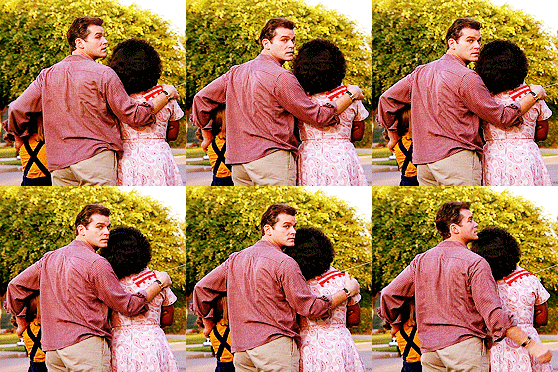
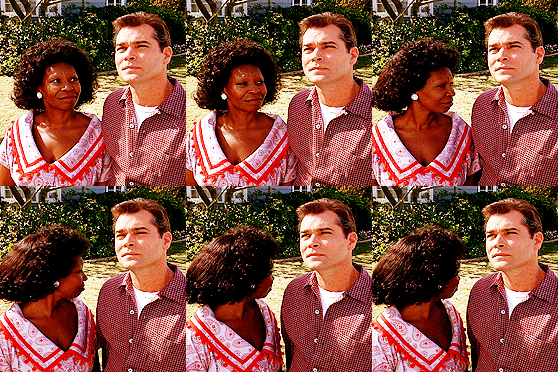
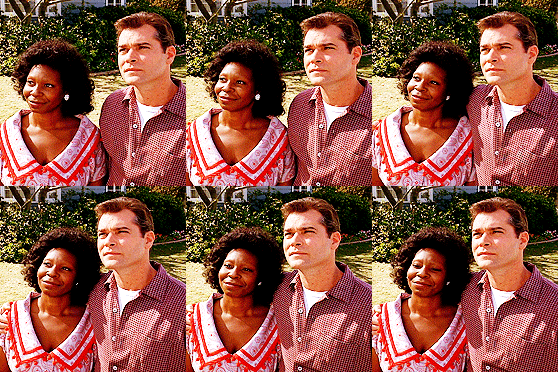
My revelation regarding this was spurred by a little-known film that actually didn’t do very well in theatres at all, from the early 90s called Corina Corina.
Starring heartthrob of the time Ray Liotta, fresh off his Goodfellas fame and…..Whoopie Goldberg??? as his love interest??????
Bear with me here.
Corina Corina is the story about a man whose wife died, leaving him alone to parent his 8-9 year old daughter alone in what appears to be the late 50s-early 60s. His daughter, Molly, is non-verbal due to the trauma of her mother’s death and is dealing with feelings of isolation as a result of her mourning process. Ray Liotta’s character makes a concentrated effort to be a good dad for her, but it’s real clear that both of them are still dealing with the death of his wife. Because Ray’s character works full time, he needs to find a nanny to watch his girl and pick her up from school. After a couple of terrible experiences (one with a hilarious appearance by Joan Cusack) he decides to hire Whoopie Goldberg.
Whoopie Goldberg’s character is a college educated black woman (in the 50s!!!!) who appears to be doing domestic work because its the only work white 50s America will hire her for. She and Ray’s daughter Molly get along well because she is the first person to take Molly’s decision to be non-verbal seriously and learn an alternate way to communicate with her.
Long story short, Whoopie Goldberg and Ray Liotta fall in love and live happily ever after.
But, more importantly, the way the movie built their love changed the way I was able to process hetero couples on screen forever.
1. First, they were both provided with alternate romance options from the beginning of the movie. Ray was given an extremely attractive white lady love interest, and Whoopie was given an attractive and charming black man love interest. Both of them were given opportunities to return their affection but both pointedly chose not to.
2. They were attracted to each other based on common interest. They both liked the same music, they both bonded over their ability to play the piano, they both loved molly, they both helped encourage each other in their chosen fields (whoopie’s was english, and ray’s was being a songwriter), they both respected each other’s opinions and they both were honest with each other about the circumstances they were in.
3. They were realistic about the issue of a black woman being in a relationship with a white man in the era, and didn’t glide over racial identity issues. Ray made sure that his white neighbors knew that he loved her and didn’t care what they thought. He even explained to his mom that Molly emulating black culture wasn’t shameful and that she should mind her business about the way he felt about Whoopie Goldberg.
4. When Ray confessed his feelings, it was incredibly heartfelt and he was literally crying.
5. They didn’t pursue a romantic relationship until Whoopie wasn’t working for him anymore. And they didn’t gloss over the issue of power disparity in that equation. Ray doesn’t condescend to Whoopie at all through the movie, but once he’s aware he has feelings for her, his new goal is to let her know that he unquestionably considers her his equal both in private and in public And its clear that he’s aware that this is the first thing that must be settled before anything else.
By the time you get to the end of the movie, the entire concept of Ray Liotta being with Whoopie Goldberg seems not only normal, but exceptionally romantic and you’re left wondering why you thought they would be a gross couple to begin with when they’re sO cLeArLy MaDe fOr eAcH oThEr
I now call this the Corina Corina standard.
If a movie has a hetero couple and their relationship isn’t as fleshed out as Ray/Whoopie, I now have difficulty accepting whats occurring.
The concept that two hot straight people who are vaguely near each other just doesn’t do it for me anymore after watching Ray Liotta walk through a black neighborhood in the 50s and knock on Whoopie’s door to beg her to come home to him.
i can only handle so much socializing until i get tired and start getting irritated towards everyone and want to go home and sleep or lock myself in my room and go on the computer



 Tumblr backup